
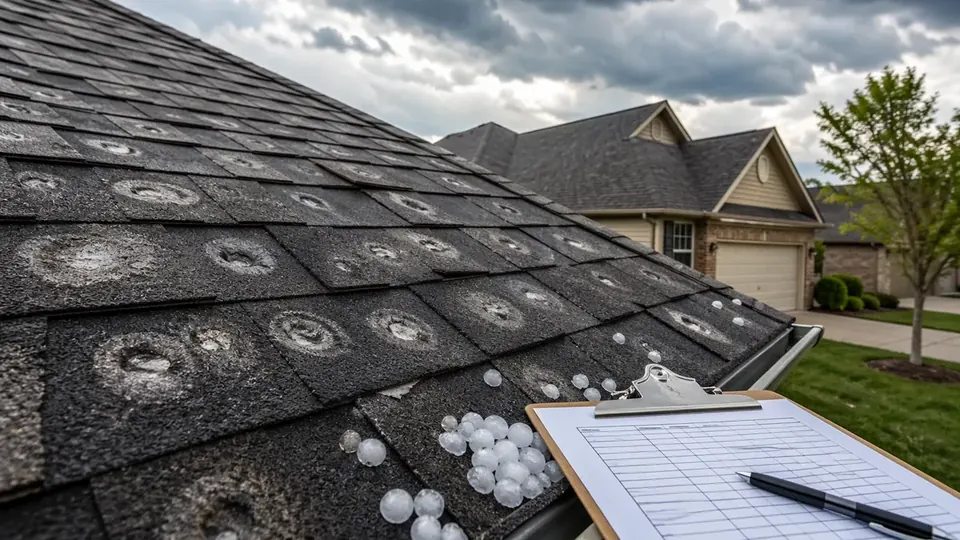
Corpus Christi hail damage claims follow a clear seasonal pattern. NOAA Storm Events data for Nueces County list 134 hail reports since the 1950s, and May alone accounts for 58 of them, with April next at 28. Large stones are not rare: a spotter photographed baseball-size hail west of Calallen on April 24, 2016 (NCEI event record), golf ball-size hail fell near Alameda Street and Airline Road on June 4, 2017, and hail estimated at 3 inches was reported at the Port Aransas airport on November 1, 2025. If you own property in Corpus Christi, Nueces County, or the wider Coastal Bend, this page explains what a hail claim usually involves and how a public adjuster may help.
Hail damage is often harder to see than it looks. Bruised shingles, cracked tiles, and dented metal can be missed from the ground, and the full scope may only show up during a careful roof inspection. Our storm history page has more on local hail events.
What Corpus Christi Hail Damage Claims Typically Cover
Hail is a covered peril on most property policies, subject to deductibles, exclusions, and endorsements. Near the coast, it is often covered by a TWIA windstorm policy rather than the homeowners policy; see TWIA windstorm claims. Hail claims often involve:
- Roofs – composition shingles (granule loss, bruising, fractured mats), metal panels, tile, and low-slope commercial membranes. See roof damage insurance claims.
- Windows and skylights – broken glass, damaged frames, and torn screens.
- Exterior walls – spatter and chips on stucco, cracked fiber cement or vinyl siding, and damaged trim and paint.
- Soft metals and equipment – gutters, downspouts, roof vents, flashing, and AC condenser fins.
- Other structures – fences, carports, sheds, and metal shops.
- Interior damage – water entering through broken windows or punctured roofing.
Documentation That Supports a Hail Claim
Strong documentation links the damage to a storm date and shows the full repair scope. Our claim documentation checklist covers this in more detail.
| Document | Why it matters |
|---|---|
| Date-stamped photos and video | Shows hail size, roof condition, and damage before repairs or tarping. |
| NOAA and NWS weather records | Helps confirm hail fell at or near the property on the date of loss. |
| Roof inspection with test squares | Records hits per square, mat fractures, and functional damage on each slope. |
| Soft-metal and collateral damage photos | Dents in vents, gutters, and AC fins help show hail size and direction. |
| Itemized repair estimate | Line-item scope (often in Xactimate) for roofing, gutters, windows, and interior work. |
| Policy and declarations page | Confirms deductibles, roof payment schedules, and cosmetic damage endorsements. |
| Receipts for emergency repairs | Supports reimbursement for tarping and mitigation. |
For a step-by-step approach, read our guide on how to document hail damage for an insurance claim.
Common Insurer Arguments on Hail Claims
Hail claims are often disputed on the details. Arguments that come up frequently include:
- "Wear and tear, not hail." The insurer attributes granule loss or cracking to age, blistering, foot traffic, or manufacturing defects. On the coast, salt-air corrosion may be cited for metal components.
- "Prior storm." The carrier says the damage happened before the policy period or during an earlier, unreported storm. Nueces County can see more than one hail day in a season, which makes dating the damage important.
- "Cosmetic only." Dents in metal roofing or soft metals are labeled cosmetic under an exclusion endorsement.
- Repair vs. replace. The estimate allows spot repairs even when brittle or discontinued materials cannot be repaired or matched.
- Missing line items. Drip edge, starter course, ridge, flashing, and code-required items are left out. Our insurance estimate review looks for these gaps.
If your hail claim was denied, ask the insurer to explain the denial in writing and identify the policy language it relied on. Our denied insurance claims page explains common next steps.
Settlement Factors: Deductibles, Depreciation, and Code
- Wind/hail deductibles. Many Texas policies, including many TWIA policies, use a separate wind/hail deductible, often a percentage of the dwelling limit. Check your declarations page.
- ACV vs. RCV. Under replacement cost coverage, insurers typically pay actual cash value first and release recoverable depreciation after repairs are completed. Some roof coverage is ACV-only or follows a payment schedule. See replacement cost vs. actual cash value in Texas.
- Ordinance or law. Corpus Christi adopted the 2021 International Residential Code with local amendments effective August 1, 2023, and re-roofing requires a city permit with a TDI WPI-1 form. Code-required upgrades are paid only under ordinance or law coverage, up to its limit.
- Limits. Other structures and personal property have their own limits.
Hail Damage Beyond Corpus Christi City Limits
Hail swaths do not stop at a city line, and some of the largest stones in the NOAA record fell in smaller communities. Baseball-size hail broke a car windshield near Petronila in May 2006, and the May 1993 storm brought golf ball to tennis ball-size hail to Banquete, west of Robstown, where the Red Cross reported roof and window damage to homes. Neighboring counties see it too: NOAA lists five reports of baseball-size or larger hail in Kleberg County and 17 reports of golf ball-size or larger hail in San Patricio County. Whether your property is in Calallen, Robstown, Kingsville, Portland, or on the islands, the same documentation steps apply. See our service areas for the communities we serve.
How a Corpus Christi Public Adjuster May Help
A Corpus Christi Public Adjuster represents the policyholder, not the insurer. On a hail claim, that may include inspecting the property, reviewing the policy and endorsements, preparing a detailed estimate, gathering weather data, and communicating with the insurer's adjuster. If the claim was already paid low, we can review it for a supplement or discuss whether appraisal may fit a dispute over the amount of loss. We cannot promise a result; outcomes depend on your policy and the facts. Fees are disclosed in a written contract before any work begins; Texas law caps public adjuster compensation at 10% of the insurance settlement.
Policyholder Responsibilities
- Give prompt notice of the loss. For TWIA, the claim must be filed within one year of the date of damage.
- Prevent further damage by tarping openings and boarding broken windows, and keep receipts.
- Preserve evidence by photographing damage and keeping samples of damaged materials when practical.
- Submit a proof of loss if the insurer requests one, within the time the policy requires.
- Cooperate with inspections and reasonable document requests.
Many policies also set a deadline to file suit. For legal questions about deadlines or a disputed claim, consult a Texas attorney.
Frequently Asked Questions
Does TWIA cover hail damage in Corpus Christi?
Yes, for eligible properties. TWIA covers wind and hail in the coastal catastrophe area, which includes Nueces, San Patricio, Aransas, and Kleberg counties. If your homeowners policy excludes wind and hail, a hail claim usually goes to TWIA, which requires the claim to be filed within one year of the date of damage.
How do I know if my roof has hail damage?
From the ground, look for dented gutters, downspouts, vents, and AC fins, and for granules collecting at downspout outlets. On the roof, hail can leave bruises, fractures, and exposed mat on shingles. A close inspection is safer and more reliable than guessing; do not climb a damaged roof yourself.
What is a cosmetic damage exclusion?
Some policies, especially for metal roofs, include an endorsement that excludes dents that do not affect the roof’s function. Whether hail damage is cosmetic or functional is a frequent dispute, so read your endorsements and ask the insurer to identify the exact language it relies on.
How do I prove which storm caused the hail damage?
Dated photos, NOAA Storm Events records, NWS reports, and the condition of soft metals can help link damage to a specific date. Our storm lookup tool is a good place to start.
Will my insurer replace the whole roof after hail?
It depends on the extent of the damage, whether materials can be repaired or matched, and your policy terms. Some hail losses support full replacement; others are scoped as repairs. A detailed inspection and estimate help show which applies.
Can a public adjuster guarantee a bigger hail settlement?
No. A public adjuster can help document the loss, review the insurer’s estimate, and present the claim, but no one can promise an outcome. Results depend on the policy and the facts.