Key takeaways
- Hurricanes are not the only source of wind damage in Corpus Christi. Squall lines, downbursts, and tornadoes produce many claims.
- On May 8, 2025, NWS surveys estimated gusts of 105 to 115 mph around Petronila, Driscoll, Palo Alto, and Agua Dulce.
- May is by far the busiest month for thunderstorm wind reports in Nueces County, followed by March, June, and April.
- In the TWIA catastrophe area, wind coverage often comes from TWIA, with its own deductible and deadlines.
- Document the damage, the date, and the weather records quickly. Wind damage can be disputed as wear and tear.
When people think about wind damage insurance claims in Corpus Christi, TX, hurricanes usually come to mind first. But many of the wind claims filed across Nueces County come from ordinary-looking spring thunderstorms that turn violent for a few minutes. A line of storms can push gusts strong enough to snap power poles, peel back roofs, and flatten fences, then move on before most people realize how bad it was. This article covers what non-hurricane wind looks like on the Coastal Bend, what the records show about when it happens, and how to handle the claim that follows.
Types of non-hurricane wind that damage Coastal Bend property
- Squall lines and bowing segments. A line of thunderstorms can produce straight-line winds along its leading edge. When part of the line bows outward, winds there are often strongest. A large, organized cluster is called a mesoscale convective system (MCS).
- Downbursts. A strong downdraft can hit the ground and spread out, producing a concentrated burst of damaging wind over a small area.
- Tornadoes. Most Nueces County tornadoes in the NCEI record are brief and weak, but some have caused real damage. An EF1 tornado on May 24, 2015, snapped and uprooted trees near Cunningham Middle School and damaged a nearby residence (NCEI event).
- Non-thunderstorm high wind. Strong pressure gradients, such as behind cold fronts, can also produce damaging gusts. NCEI lists 19 high wind reports for Nueces County.
The May 8, 2025 windstorm
The clearest recent example is May 8, 2025, when a mesoscale convective system tore across western Nueces County. NWS storm surveys estimated gusts of 105 to 115 mph, strong enough to snap rows of power poles and move mobile homes off their foundations. These are among the strongest thunderstorm wind reports in the county’s NCEI record.
| Location | Estimated gust | NCEI description (summarized) | Record |
|---|---|---|---|
| Petronila | 115 mph | Numerous power poles snapped, some near the top third | NCEI 1249160 |
| Driscoll | 115 mph | NWS storm survey estimates 115 mph winds with the MCS | NCEI 1247377 |
| Driscoll | 110 mph | A 30 ft tree uprooted, damaging a house roof and siding | NCEI 1247379 |
| Palo Alto | 110 mph | Around 80 power poles snapped near the base | NCEI 1249120 |
| Petronila | 110 mph | Barn roof damage shown in social media photos | NCEI 1247376 |
| Petronila | 105 mph | Mobile home blown off foundation into the street; carport roof blown off | NCEI 1247382 |
| Agua Dulce | 105 mph | 80 transmission lines blown down | NCEI 1247378 |
Gusts in that range are comparable to what many people associate with hurricanes, yet they came from a spring line of storms. For homeowners, the lesson is simple: a non-hurricane windstorm can still produce a major claim, and the documentation should be just as thorough.
Strong spring wind has continued since. On May 23, 2026, NCEI records an estimated 85 mph gust in Corpus Christi that snapped a large tree trunk (NCEI event), with measured gusts of 66 mph at Corpus Christi International Airport and 68 mph at the Naval Air Station the same day. (2026 data is preliminary.)
When thunderstorm wind happens in Nueces County
The NCEI Storm Events Database lists 287 thunderstorm wind reports for Nueces County. Counts are individual reports, not storm days, but the pattern is clear:
| Month | Thunderstorm wind reports (Nueces County) |
|---|---|
| May | 110 |
| March | 41 |
| June | 38 |
| April | 35 |
| August | 13 |
| September | 13 |
| October | 10 |
| November | 10 |
| January | 7 |
| February | 7 |
| July | 3 |
May alone accounts for more than a third of all thunderstorm wind reports in the county. Spring is also peak hail season locally, so wind and hail claims often come from the same storms. See our Corpus Christi storm history article for more.
What wind damage looks like on local construction
Composition shingle roofs
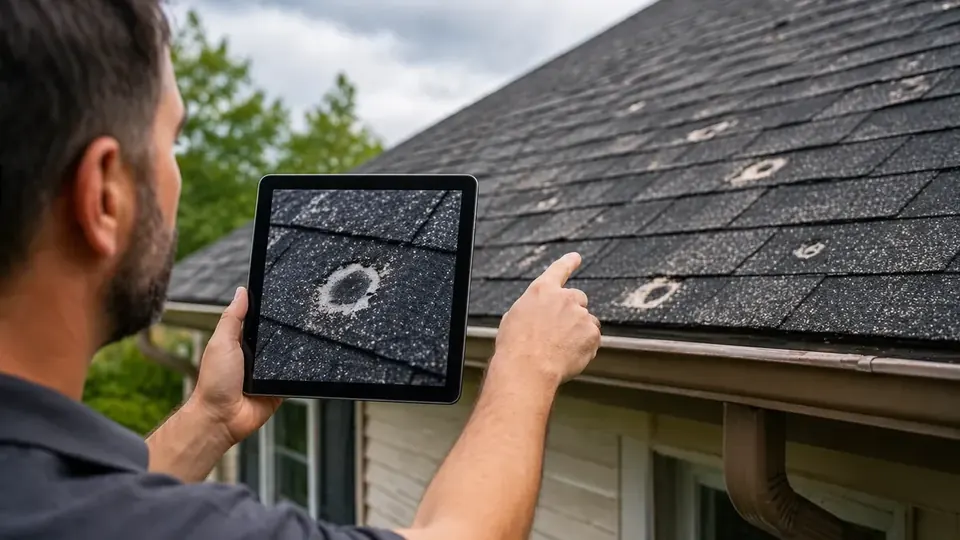
Look for missing shingles, lifted or creased tabs, broken seal strips, displaced ridge and hip caps, and exposed nail heads. A crease across the top of a tab often means it was lifted and folded by wind, even if it laid back down. Damage often concentrates on edges, corners, and ridges, where wind pressure is highest.
Metal roofs
Check for lifted or bent panels, loosened or missing fasteners, displaced trim and ridge caps, and torn sealant at laps. Long-term salt-air corrosion is common near the bays, so clear photos showing fresh bends and tears help separate storm damage from wear.
Siding, soffits, and openings
Wind can strip vinyl or fiber cement siding, pull soffit and fascia loose, crack stucco around impacted areas, and break windows and garage doors. Once an opening exists, wind-driven rain can damage ceilings, insulation, and walls inside.
Fences, carports, and outbuildings
These are often the first to fail. Photograph the direction they fell, since a consistent direction across a neighborhood helps show a single wind event.
Trees
Wind-felled trees can damage roofs, walls, and vehicles. Coverage for damage the tree caused is usually treated differently from coverage for removing the tree itself, so read your policy.
Rural properties, mobile homes, and outbuildings
The May 8, 2025 reports came mostly from rural western Nueces County, and they show the kinds of property that tend to take the worst of a severe wind event: manufactured homes, carports, barns, and other outbuildings. These structures often have lighter framing and fewer connections than a site-built house, so they can fail at lower wind speeds and in more dramatic ways.
Claims for this kind of property raise their own questions:
- Which coverage applies. Detached structures are often covered under “other structures” with a separate limit, while a manufactured home may be insured under a different type of policy altogether. Farm and ranch buildings may be on a farm policy.
- Repair vs. total loss. When a mobile home is moved off its foundation, the frame, utility connections, and interior can all be affected. Whether it can be reset and repaired, or should be treated as a total loss, is often a central question.
- Debris removal. Policies frequently have separate or limited coverage for debris removal. Keep records of what it costs to clear the site.
- Contents. Equipment, tools, and stored items inside a barn or shop may fall under different coverage parts. Photograph them where they lie before moving anything.
Common reasons wind claims are underpaid or denied
- “Wear and tear” or “age.” The insurer attributes lifted shingles or loose metal to deterioration rather than wind.
- “No storm on that date.” The insurer questions whether damaging wind actually reached the property. Weather records and nearby NCEI reports help here.
- Repair instead of replacement. The estimate calls for spot repairs where a repair may not be workable, for example where shingles are brittle, discontinued, or cannot reasonably be matched.
- Missing components. Items such as drip edge, flashing, starter strips, ridge vents, and underlayment can be left out of the scope.
- Interior damage overlooked. Water that entered through a wind opening can stain ceilings, wet insulation, and damage drywall, and some of it may not show until days later.
If you are facing one of these issues, our pages on roof damage insurance claims and underpaid insurance claims explain how they are typically addressed.
How wind claims are covered on the Coastal Bend
Nueces, San Patricio, Aransas, and Kleberg counties are all in the TWIA designated catastrophe area. For many homeowners there, including inland communities like Robstown and Kingsville, wind and hail coverage comes from TWIA, and the homeowners policy excludes wind. Some owners have wind coverage from a private carrier instead. Either way, check the declarations page for the wind/hail deductible, which is often a percentage of the dwelling limit.
If your wind coverage is through TWIA, the claim must be filed no later than one year after the date of damage, and TWIA has statutory deadlines to request information, decide, and pay. Our TWIA claim process guide lists each one.
Steps after a windstorm
- Stay safe. Avoid downed lines and do not climb onto a damaged roof.
- Prevent further damage. Tarp openings, board broken windows, and keep receipts.
- Document quickly. Photograph the roof from the ground, all sides of the house, fences, outbuildings, and interior water damage. Include close-ups and wide shots.
- Record the date and time. Save time-stamped photos, videos, and weather alerts. Use our storm lookup tool to find NCEI reports near your property.
- Report the claim to the insurer that covers wind for your property.
- Meet the adjuster prepared. Have your photos, a list of damage, and receipts ready. Our claim documentation checklist can help.
Insurers sometimes attribute lifted shingles or loose panels to age or poor installation rather than wind. Dated photos of the roof before the storm, weather records for the date, and a consistent damage pattern all help show what the storm did.
How a public adjuster can help
A licensed public adjuster represents the policyholder, not the insurer. On a wind claim, that can include inspecting and documenting the damage, matching it to weather records, preparing a detailed estimate, and handling communication with the carrier. Corpus Christi Public Adjuster serves Corpus Christi, Nueces County, and surrounding Coastal Bend communities. Learn more on our wind damage claims page. If your claim has already been turned down, ask for the denial reason in writing before deciding on a next step. Fees are disclosed in a written contract before any work begins; Texas law caps public adjuster compensation at 10% of the insurance settlement.
If a recent windstorm damaged your home or business and you are not sure what your policy covers, a Corpus Christi Public Adjuster free claim review can help you sort out the next step.
Frequently Asked Questions
Does TWIA cover wind damage that is not from a hurricane?
TWIA covers wind and hail losses for eligible properties in the designated catastrophe area, which includes Nueces, San Patricio, Aransas, and Kleberg counties. Its coverage is not limited to hurricanes, so damage from a thunderstorm, squall line, or other windstorm may be covered, subject to the policy terms and deductible.
What does wind damage on a shingle roof look like?
Common signs include missing shingles, shingles that are lifted, creased, or folded back, broken seal strips, displaced ridge and hip caps, exposed nails, and damaged flashing. Creases along the top of a shingle tab are a frequent sign that it was lifted by wind even if it fell back into place.
How do I prove the date of a windstorm?
Time-stamped photos and videos are a good start. You can also check the NOAA NCEI Storm Events Database and National Weather Service records for wind reports near your property on that date. Records of measured gusts at nearby stations, such as Corpus Christi International Airport, can help support your timeline.
Is a fallen tree covered by my policy?
It depends on the policy and where the tree landed. Damage to the house or another covered structure from a wind-felled tree is often covered as wind damage. Coverage for removing the tree itself, or for a tree that fell without hitting a structure, is often limited. Read the policy wording or ask your adjuster.
What if the insurer says the damage is wear and tear?
Ask for the reason in writing and for any inspection or engineering report. Then compare it with your own photos, the storm records for that date, and the damage pattern. A licensed public adjuster can help document storm-related damage. If the claim is denied and you are considering legal action, talk to a Texas attorney.
Sources and further reading
This article is general information about property insurance claims in Texas, not legal advice, and not a promise of any coverage or outcome. Your policy language and the facts of your loss control your claim.